
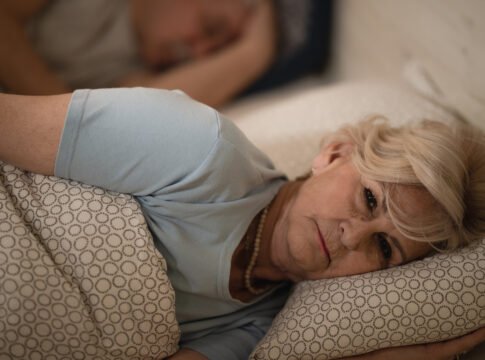
You go to bed at a reasonable hour. You lie there. Your mind doesn’t stop. Or you fall asleep easily enough but wake at 3am with thoughts circling that you can’t switch off. Or you sleep a full eight hours and wake feeling like you haven’t slept at all — heavy, foggy, already behind. If any of this sounds like your life, you are not unusual. Sleep fragmentation, early waking, difficulty falling asleep, and unrefreshing sleep are not random inconveniences. They are specific, well-documented changes in sleep architecture that become increasingly common from the mid-30s onward — and they have causes that are far more addressable than most people realise.
The science: what is happening to your sleep
Sleep is not a single state — it is a structured cycle of distinct stages, each serving different biological functions. Deep slow-wave sleep (Stage N3) is when the body releases growth hormone, repairs tissue, clears metabolic waste from the brain via the glymphatic system, and consolidates procedural memory. REM sleep is when emotional processing occurs and declarative memories are integrated. Both stages decline meaningfully with age. Slow-wave sleep typically decreases by around 2% per decade from the 20s, and by the mid-40s, most adults are spending significantly less time in the most restorative phases of sleep — even if total sleep duration appears adequate. This is why eight hours of sleep at 42 often feels less restorative than six hours at 25.
The architecture changes are partly driven by shifts in circadian rhythm — the internal biological clock that regulates sleep-wake timing. In this decade, the circadian system becomes slightly less robust, making the body more sensitive to the things that disrupt it: artificial light, irregular schedules, alcohol, and the cortisol surges of unmanaged stress. Additionally, sleep-disordered breathing — including obstructive sleep apnoea — becomes significantly more prevalent in the 35–50 age group, particularly in men and in women approaching perimenopause. Apnoea fragments sleep without the sufferer realising it, producing profound daytime fatigue from what appears on paper to be a full night’s sleep.
Why this age group is uniquely at risk
The 35–45 decade stacks biological sleep changes on top of the most socially and professionally demanding period of modern adult life. Parental responsibilities, peak career pressure, financial obligations, and the psychological weight of managing everything simultaneously all activate the stress response — which elevates cortisol and adrenaline in the evening, directly counteracting the melatonin rise that initiates sleep onset. Alcohol, which many adults in this group use as a winding-down tool, fragments sleep in the second half of the night by suppressing REM and triggering rebound arousal as it metabolises. Screens and device use after dark suppress melatonin synthesis at precisely the time it needs to rise. And the chronic sleep debt accumulated over this decade is not simply repaid by weekend sleep-ins — the structural damage to health from sustained sleep deprivation is cumulative.
- Waking consistently between 2am and 4am with an inability to return to sleep
- Unrefreshing sleep — waking feeling as tired as when you went to bed
- Loud snoring reported by a partner, or gasping during sleep (possible sleep apnoea)
- Daytime sleepiness that affects concentration or requires caffeine to function after midday
- Irritability, emotional reactivity, or low frustration tolerance disproportionate to circumstances
- Reliance on alcohol to fall asleep, or an inability to sleep without it
- Difficulty staying awake during low-stimulation activities — meetings, reading, watching television
What lifestyle changes actually help
Cognitive Behavioural Therapy for Insomnia (CBT-I) is the most evidence-backed intervention for chronic sleep problems and is now recommended above sleep medication as a first-line treatment by major sleep medicine bodies. It works by addressing the thoughts, behaviours, and habits that perpetuate insomnia — including the anxiety about not sleeping that itself becomes a cause of not sleeping. Its effects are more durable than medication and have no side effects. Sleep restriction therapy — temporarily reducing time in bed to consolidate fragmented sleep — is counterintuitive but highly effective and forms a key component of CBT-I.
Beyond CBT-I, sleep hygiene is most effective when understood mechanistically rather than as a checklist. Light is the primary circadian signal — morning bright light exposure (10 to 30 minutes outdoors within an hour of waking) anchors the circadian rhythm earlier and makes evening melatonin onset more reliable. Blue light from screens after 9pm delays melatonin by 90 minutes or more; blue-light-blocking glasses or screen dimming genuinely mitigates this. A cool bedroom (around 18°C / 65°F) supports the core body temperature drop that initiates and maintains sleep. Alcohol should ideally be avoided within four hours of bedtime — not reduced, but avoided, given its specific suppression of REM sleep. Regular aerobic exercise improves slow-wave sleep depth, though high-intensity training within two hours of bed can impair sleep onset.
- Get 10–30 minutes of outdoor morning light within an hour of waking — this is the most powerful circadian anchor available
- Set a consistent wake time 7 days a week, regardless of bedtime — regularity drives circadian robustness
- Stop alcohol at least 4 hours before bed; if sleep is chronically poor, trial complete abstinence for 4 weeks
- Dim screens and use blue-light blocking settings from 9pm onward
- Keep the bedroom at 18°C (65°F) — cooler than feels intuitive, but optimal for sleep physiology
- Ask your GP for a sleep study if snoring, gasping, or unrefreshing sleep are present — sleep apnoea is common and treatable
- Explore a CBT-I programme — apps, books, or clinician-delivered — for persistent insomnia before considering medication
The overlooked factor: your chronotype may have shifted
Most people are aware that teenagers naturally shift to a later sleep phase — a biological phenomenon, not laziness. What fewer people know is that adults in their 30s and 40s can experience a return shift toward an earlier chronotype: an internal clock that naturally inclines toward earlier bedtimes and earlier waking. When this conflicts with the social and professional demands of late-night work, evening childcare, or screen time, the result is a form of social jet lag — a daily mismatch between internal biology and external schedule. This produces a persistent fatigue that no amount of caffeine reliably resolves, because the issue is not quantity of sleep but misalignment of its timing. Identifying your natural chronotype — through tools like the Munich Chronotype Questionnaire — and adjusting sleep timing, even slightly, can produce dramatic improvements in how rested you actually feel. It is one of the most underused levers in sleep optimisation.
